 EN
 DE
 ES
 FR
 NL
 PL
 ZH
 IT
 RU
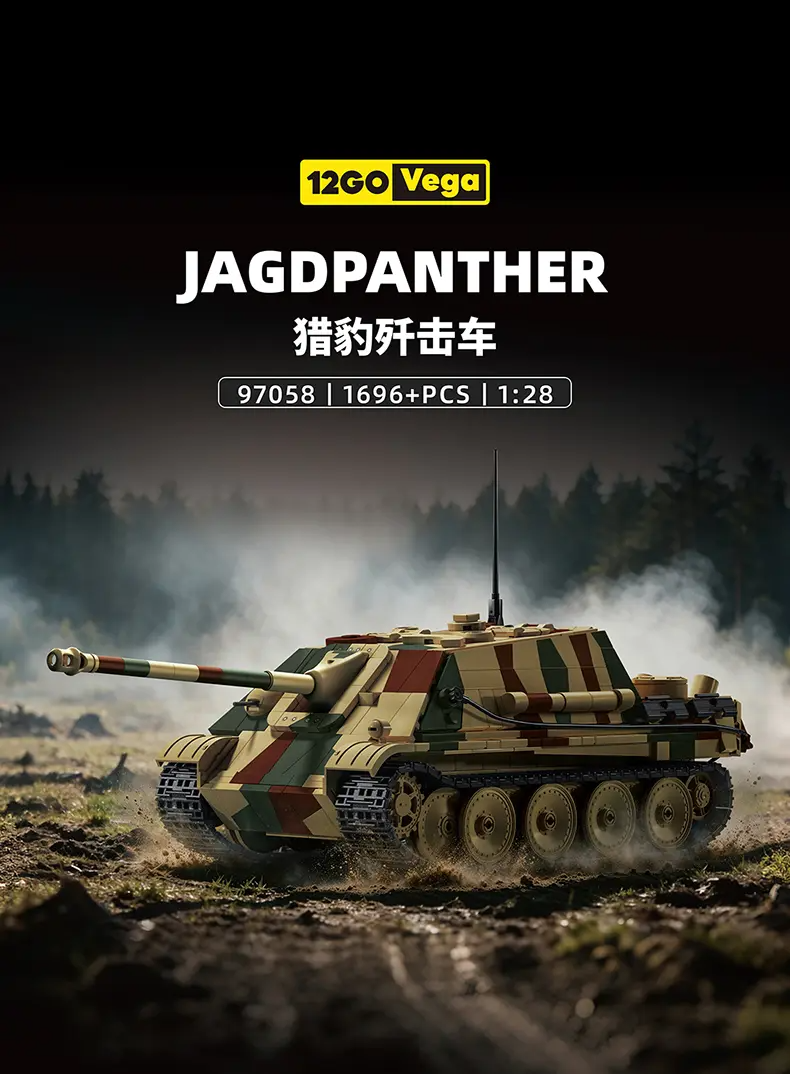
Jagdpanther
- 97058Catalog number
- 12GOManufacturer
- 1696Pieces
- 1:28Scale
- 36.2 × 12.7 × 16.8 cmProduct size
- 42 × 11.5 × 28.5 cmPackage size
- 14+Age
- ABS plasticMaterial
Top offers for Jagdpanther
Current prices for Jagdpanther at partner stores (sorted lowest first).
 AfobrickBest price$55.86incl. shippingCode PBRICKS: 5% offView offer
 YourwobbCheck store for priceCode PBRICKS: 4% offView offer
 AliExpressCheck store for priceView offer
 BarweerCheck store for priceView offer
 Amazon (EU)Check store for priceView offer
- Amazon (US)Check store for priceView offer
Prices may change. We may earn a commission if you buy via partner links — at no extra cost to you.
About Jagdpanther set
The 12GO Jagdpanther 97058 is a detailed building set inspired by one of the most recognisable German tank destroyers of the Second World War. The model recreates the Jagdpanther, a vehicle based on the Panther tank chassis and armed with a powerful 88 mm anti-tank gun. The set contains more than 1696 pieces and is designed in 1:28 scale. Once assembled, the model measures approximately 36.2 cm in length, 12.7 cm in width and 16.8 cm in height.
One of the set's most distinctive features is the sloped, turretless superstructure with its long gun barrel. The model is finished in a multi-colour camouflage pattern combining sand beige, green and reddish-brown tones. Other notable details include carefully reproduced tracks, road wheels, side fittings, external equipment and the characteristic exhaust outlets at the rear.
The model incorporates several functional features that add interest to both the building process and the finished display. The main gun has an adjustable position, while numerous hatches and panels can be opened to reveal construction details. Removable sections of the upper structure provide access to the interior, where selected mechanical components and equipment are represented. Its layered construction makes assembling the individual modules an engaging building challenge.
The set also includes five brick-built figures, together with additional equipment and weapon accessories. These elements allow the completed model to be displayed on its own or used as the centrepiece of small scenes inspired by German armoured units.
The 12GO Jagdpanther 97058 is an appealing choice for military history enthusiasts, armoured vehicle collectors and builders looking for a substantial construction project. Its high piece count, distinctive tank destroyer silhouette, opening sections and included figures combine to create a detailed model suitable for both building and display.
Product features
- Brand: 12GO
- Set number: 97058
- Name: Jagdpanther
- Piece count: 1696+
- Scale: 1:28
- Recommended age: 14+
- Assembled dimensions: 36.2 × 12.7 × 16.8 cm
- Box dimensions: 42 × 11.5 × 28.5 cm
- German tank destroyer inspired by the historical Jagdpanther (Sd.Kfz. 173)
- Characteristic turretless superstructure and long gun barrel
- Adjustable main gun
- Opening hatches and panels
- Removable sections of the upper structure
- Detailed interior and mechanical components
- Detailed running gear with road wheels and tracks
- Characteristic rear exhaust details
- Multi-colour camouflage in beige, green and reddish-brown
- Five brick-built figures
- Additional accessories and equipment
- Building set suitable for construction, interactive play and collector display
Historical background – The Jagdpanther: combining firepower and mobility
The Jagdpanther (Sd.Kfz. 173) was a German tank destroyer developed during the Second World War in response to the growing threat posed by heavily armoured enemy vehicles. German designers wanted to create a vehicle capable of carrying the powerful 8.8 cm PaK 43 L/71 anti-tank gun while retaining the mobility and protection expected of a modern armoured fighting vehicle. Rather than developing an entirely new chassis, they chose to build the vehicle around the proven chassis of the Panther tank.
Development work began in 1942. Several chassis options were initially considered, but the Panther was eventually selected as the basis for the new tank destroyer. The project involved several German companies, with MIAG of Brunswick playing an important role in completing the design and preparing it for production. The first prototypes appeared in autumn 1943, and series production began in January 1944. Production was later expanded to include MNH in Hanover and MBA in Potsdam. Approximately 400 vehicles were built, although historical sources quote different totals depending on their counting methods and whether vehicles completed after the war are included.
The Jagdpanther's defining feature was its 8.8 cm PaK 43 L/71 gun, one of the most effective German anti-tank weapons of the period. Its long barrel and high muzzle velocity gave it considerable armour-piercing capability at long range. Instead of a conventional rotating turret, the gun was installed in a fixed superstructure. This arrangement reduced the vehicle's height and made it possible to mount a powerful weapon within a relatively compact silhouette. However, the gun had a limited traverse, so the entire vehicle often had to be repositioned to aim at a target outside that range.
The designers also placed considerable emphasis on crew protection. The front and side armour plates of the superstructure were heavily sloped, increasing their effective resistance to incoming fire. The Jagdpanther shared its powertrain and many technical features with the Panther, including the Maybach HL230 engine. This combination gave it considerably better mobility than earlier heavy tank destroyers such as the Ferdinand, while retaining formidable firepower and protection. Nevertheless, the vehicle was not free from technical problems. The weight of the gun and the additional load on the front of the vehicle contributed to drivetrain failures and maintenance difficulties, particularly during its early service.
Jagdpanthers began reaching combat units in 1944. One of the first formations to receive them was schwere Panzerjäger-Abteilung 654, a heavy tank destroyer battalion that fought in Normandy. The vehicles were also deployed elsewhere on the Western Front and later took part in the fighting during the German Ardennes Offensive. Their primary role was to engage enemy tanks at long range, preferably from concealed positions where their powerful gun and the advantages of the terrain could be used effectively.
The Jagdpanther became one of the most successful German designs in the heavy tank destroyer category. It combined powerful armament, sloped armour and relatively good mobility on the Panther chassis. Its overall impact was limited, however, by low production numbers, technical difficulties and the increasingly strained industrial and logistical situation in Germany during the final stages of the war. Today, the Jagdpanther remains one of the most recognisable German armoured vehicles, admired by historians and collectors for its distinctive silhouette and combination of firepower and protection.