 EN
 DE
 ES
 FR
 NL
 PL
 ZH
 IT
 RU
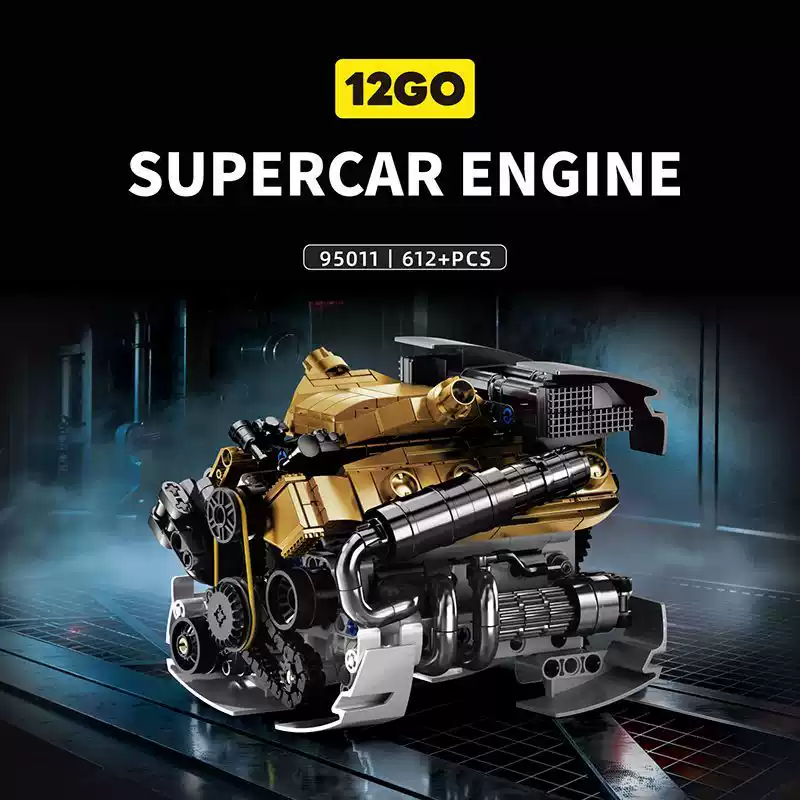
12GO Supercar Engine Other - 95011
- 95011Catalog number
- 12GOManufacturer
- 612Pieces
- OtherScale
- 14.5 × 12 × 11.5 cmProduct size
- 6+Age
- ABS plasticMaterial
Top offers for Supercar Engine
Current prices for Supercar Engine at partner stores (sorted lowest first).
 YourwobbBest price$9.18excl. shippingCode PBRICKS: 4% offView offer
 AfobrickCheck store for priceCode PBRICKS: 5% offView offer
 BarweerCheck store for priceView offer
 AliExpressCheck store for priceView offer
 Amazon (EU)Check store for priceView offer
- Amazon (US)Check store for priceView offer
Prices may change. We may earn a commission if you buy via partner links — at no extra cost to you.
About Supercar Engine set
The 12GO Supercar Engine 95011 is a technical building set featuring a detailed mechanical engine assembly inspired by the power units found in high-performance supercars. Consisting of more than 612 pieces, the model combines an eye-catching appearance with an intricate mechanical structure. Gold-coloured engine components, silver exhaust pipes, black mechanical elements and exposed gears create an impressive miniature that looks engaging both during construction and when displayed.
The main highlight of the set is its mechanism designed to represent the operation of an internal combustion engine. The construction includes moving piston elements as well as a system of gears and pulleys that demonstrate how individual components interact. The mechanism can rotate in both directions, allowing builders to observe how movement is transferred through the assembly. Its exposed design makes the internal components easy to examine and gives the model an educational aspect.
Special attention has also been paid to the engine's exterior appearance. The gold-coloured engine block contrasts with metallic silver exhaust components, black pipes and mechanical details. Visible pulleys, belts, pipes and structural elements give the model an authentic technical character. The complete assembly is mounted on a stable display base, making it easy to present from different angles.
The set will appeal not only to sports car enthusiasts but also to anyone interested in mechanics, engineering and technical building models. The construction process requires attention to detail and offers an opportunity to explore how the individual parts of a mechanical system work together. Once completed, the model becomes a compact display piece suitable for a desk, shelf or automotive collection.
The manufacturer also provides the option of upgrading the construction with an electric drive. This conversion requires one Motor M and one Battery Box No.7. Both components must be purchased separately and are not included in the standard set. Once the additional components are installed, the model can be converted into an electrically powered demonstration of the engine mechanism.
When assembled, the engine measures approximately 14.5 cm in length, 12 cm in width and 11.5 cm in height. The 12GO Supercar Engine 95011 is an appealing choice for automotive enthusiasts, engineering fans and collectors of mechanical building models who want to combine an engaging building experience with an opportunity to explore moving engine components.
Technical background – How does a supercar engine work?
The internal combustion engine is one of the most important components of a modern car. Its purpose is to convert the chemical energy stored in fuel into mechanical energy, which can then be used to propel the vehicle. In supercars, engines are designed to deliver very high power, rapid throttle response and reliable operation at high engine speeds. Achieving these characteristics requires the precise coordination of numerous mechanical components, together with effective temperature control, lubrication and airflow management.
In a typical four-stroke internal combustion engine, the operating cycle consists of four stages. During the intake stroke, the cylinder receives an air-fuel mixture or air alone, depending on the engine design. During the compression stroke, the piston moves upwards and compresses the contents of the cylinder. In a petrol engine, the spark plug ignites the mixture, creating pressure that pushes the piston downwards. This is the power stroke, during which chemical energy is converted into mechanical movement. Finally, during the exhaust stroke, burnt gases are expelled through the exhaust valves.
The pistons move back and forth inside the cylinders, but the vehicle ultimately needs rotational movement to drive its wheels. This conversion is performed by the crank mechanism. Connecting rods link the pistons to the crankshaft, transferring force from the pistons and causing the shaft to rotate. The rotating crankshaft can then supply power to other systems and, through the transmission, ultimately to the wheels. The interaction between pistons, connecting rods and the crankshaft is fundamental to the operation of a conventional piston engine.
The valve timing system is another essential part of the engine. It controls when the intake and exhaust valves open and close, ensuring that this process remains synchronised with crankshaft rotation. Many engine designs use a timing belt or chain to transfer movement to one or more camshafts. Separate belt-driven systems can also operate auxiliary components. Correct timing and appropriate gear ratios are essential for efficient and reliable engine operation.
In high-performance supercars, reducing the mass of moving components, minimising mechanical friction and maintaining effective cooling are particularly important. Engines operating at high speeds generate considerable heat and therefore require efficient cooling and lubrication systems. Engineers also focus on material strength, manufacturing precision and the careful balancing of rotating components. These factors influence an engine's performance, durability and overall operating characteristics.
The 12GO Supercar Engine offers an opportunity to explore some of the mechanical principles behind this type of power unit. Its moving components, visible gears and belt-drive arrangement help illustrate how the movement of one component affects the rest of the mechanism. It is not a real combustion engine and does not burn fuel; instead, it is a brick-built demonstration of selected mechanical principles used in automotive engineering. This makes it both an attractive display model and an engaging way to explore the fundamentals of engine mechanisms.
Specifications
- Brand: 12GO
- Set number: 95011
- Name: Supercar Engine
- Piece count: 612+
- Assembled dimensions: approx. 14.5 × 12 × 11.5 cm
- Recommended age: 6+
Product features
- Brand: 12GO
- Set number: 95011
- Name: Supercar Engine
- Piece count: 612+
- Assembled dimensions: approximately 14.5 × 12 × 11.5 cm
- Detailed construction inspired by supercar engines
- Gold-coloured engine components and silver exhaust details
- Visible pulleys, drive belts and gears
- Mechanism with moving elements representing piston operation
- Mechanism can rotate in both directions
- Exposed construction for examining the internal components
- Stable display base
- Optional electric-drive upgrade
- Electric conversion requires: Motor M × 1 and Battery Box No.7 × 1
- Motor M and Battery Box No.7 are not included in the standard set