 EN
 DE
 ES
 FR
 NL
 PL
 ZH
 IT
 RU
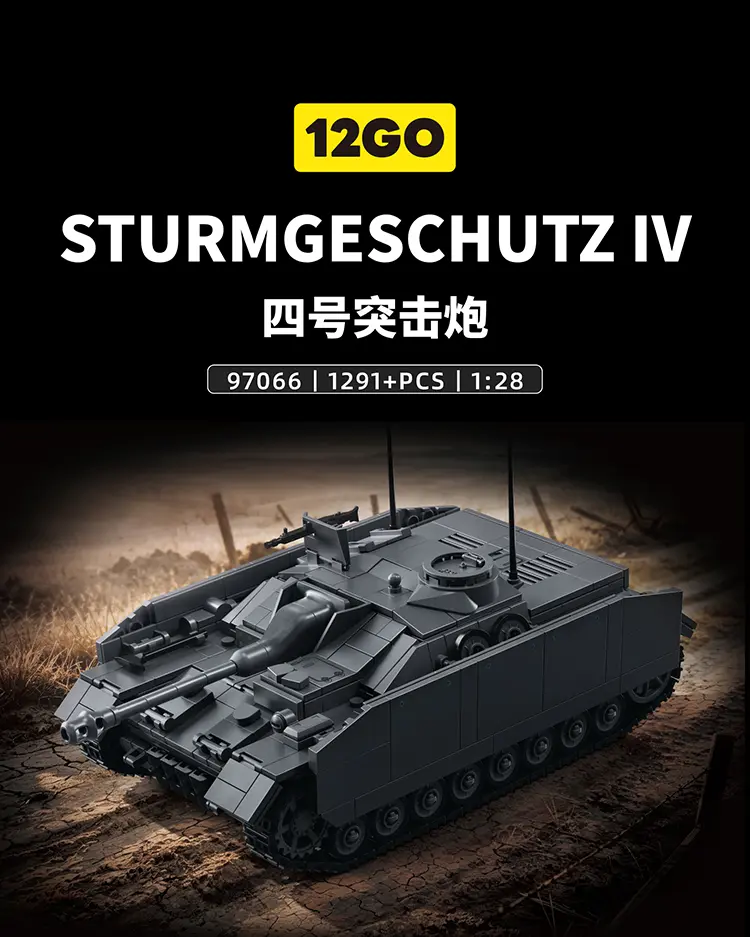
Sturmgeschütz IV
- 97066Catalog number
- 12GOManufacturer
- 1291Pieces
- 1:28Scale
- 24.5 × 12.7 × 13.3 cmProduct size
- 42 × 28.5 × 11.5 cmPackage size
- 14+Age
- ABS plasticMaterial
Top offers for Sturmgeschütz IV
Current prices for Sturmgeschütz IV at partner stores (sorted lowest first).
 AfobrickBest price$46.20incl. shippingCode PBRICKS: 5% offView offer
 BarweerCheck store for priceView offer
 YourwobbCheck store for priceCode PBRICKS: 4% offView offer
 AliExpressCheck store for priceView offer
 Amazon (EU)Check store for priceView offer
- Amazon (US)Check store for priceView offer
Prices may change. We may earn a commission if you buy via partner links — at no extra cost to you.
About Sturmgeschütz IV set
Discover one of the most distinctive German armoured fighting vehicles of World War II with the 12GO Sturmgeschütz IV 97066 building set. This brick-built model recreates the German StuG IV assault gun, a vehicle developed using the Panzer IV chassis and a low, fixed superstructure derived from the StuG III. Its characteristic turretless design, long-barrelled main gun and prominent side armour make it an appealing subject for military history enthusiasts and collectors of historical armoured vehicles.
The set contains 1291+ pieces and is designed in 1:28 scale. Once assembled, the model measures approximately 24.5 cm long, 12.7 cm wide and 13.3 cm high. The dark grey colour scheme emphasises the vehicle's angular construction, while the detailed tracks, road wheels, armour plates and exterior equipment create a convincing armoured vehicle profile.
The model includes a range of functional and removable components that make the building experience more engaging. The main gun features adjustable elevation, while selected equipment and weapon elements can be repositioned. Opening hatches and removable upper sections provide access to the interior, revealing recreated details of the fighting compartment and engine area. Its modular construction also allows individual sections to be examined more closely during and after assembly.
The design incorporates several recognisable features of the historical Sturmgeschütz IV, including its fixed fighting compartment, commander's cupola, MG34 machine gun with protective shield and mounting, side armour skirts, tracks and road wheels. Together, these details give the model the distinctive appearance of a German assault gun rather than a conventional turreted tank.
The 12GO Sturmgeschütz IV 97066 is a substantial building project for collectors interested in German armoured vehicles of World War II. It combines an engaging assembly process, functional details and the history of a vehicle that played an important role on European battlefields.
Product Features
- Brand: 12GO
- Set Name: Sturmgeschütz IV
- Set Number: 97066
- Piece Count: 1291+
- Scale: 1:28
- Assembled Dimensions: Approx. 24.5 × 12.7 × 13.3 cm
- Packaging Dimensions: Approx. 42 × 28.5 × 11.5 cm
- Age: 14+
Key Features
- Assault gun with fixed superstructure
- Main gun with adjustable elevation
- Commander's cupola
- MG34 machine gun with protective shield and mounting
- Opening hatches and movable equipment details
- Removable upper sections for viewing the interior
- Recreated fighting compartment and engine details
- Side armour skirts
- Detailed tracks and road wheels
- Modular construction for assembly and display
Historical Background: Sturmgeschütz IV - An Effective Assault Gun Built on the Panzer IV Chassis
The Sturmgeschütz IV, commonly known as the StuG IV, was a German assault gun developed in late 1943. Its introduction was driven by the growing demand for armoured fire-support vehicles and serious production difficulties affecting other German assault guns. The design combined the chassis of the Panzer IV with a modified fighting compartment derived from the StuG III Ausf. G. The result was a low-profile, turretless armoured vehicle with its main gun mounted in a fixed superstructure at the front of the hull.
Assault guns had originally been conceived primarily as direct-fire support vehicles for infantry. Their purpose was to destroy fortified positions, machine-gun nests, field defences and other targets that could obstruct an advance. Unlike conventional tanks, they did not require a fully rotating turret. Their fixed superstructure allowed the gun to be mounted within a relatively low and heavily armoured structure. This design offered practical advantages, particularly when operating from concealed or prepared firing positions.
As the war progressed, the ability to engage enemy tanks became increasingly important. The introduction of long-barrelled 75 mm guns, including the 7.5 cm StuK 40 L/48, significantly improved the anti-tank capabilities of German assault guns. Their role consequently expanded beyond infantry support, and they became increasingly important as mobile anti-tank weapons. This change was particularly significant on the Eastern Front, where German units faced growing numbers of increasingly capable Soviet armoured vehicles.
The immediate reason for developing the StuG IV was the severe damage inflicted on the Alkett factory in Berlin-Borsigwalde during Allied bombing raids in November 1943. Alkett was a major manufacturer of the StuG III, and the disruption threatened the supply of assault guns to German units. To reduce the impact of these production losses, the decision was made to combine the Panzer IV chassis with a suitably modified superstructure based on the StuG III. This approach allowed existing manufacturing capacity to be used and helped maintain the supply of armoured fighting vehicles.
Serial production of the StuG IV began in December 1943, with Krupp's factories in Magdeburg responsible for its manufacture. The first vehicles made use of available Panzer IV chassis, while subsequent examples were produced as a dedicated variant. Production continued until the final months of the war, with approximately 1,140 vehicles built. Although the StuG IV was less numerous than the StuG III, it became an important addition to German assault gun and anti-tank formations.
The main armament was the 7.5 cm StuK 40 L/48 gun, supported by an MG34 machine gun for defence against enemy infantry. The vehicle had a crew of four. Its low profile, effective main gun and armoured fighting compartment made it suitable for engaging targets from prepared positions and supporting ground forces. StuG IVs served in independent assault gun brigades and in units attached to infantry and armoured divisions.
The use of the Panzer IV chassis also offered logistical advantages. Shared components made the supply of spare parts and vehicle maintenance easier, as German armoured forces already operated large numbers of vehicles based on this chassis. The fixed superstructure, however, required the crew to turn the entire vehicle when aiming significantly away from its current direction. The gun had a limited horizontal traverse, but it could not offer the unrestricted aiming capability of a conventional tank turret.
The Sturmgeschütz IV is an example of how German wartime vehicle production adapted to changing military circumstances. Rather than being a completely new design developed from the ground up, it combined existing and proven components to meet an urgent demand for additional armoured vehicles. Its history highlights the importance of manufacturing capacity, component availability and production continuity, alongside the battlefield performance of the vehicle itself.