 EN
 DE
 ES
 FR
 NL
 PL
 ZH
 IT
 RU
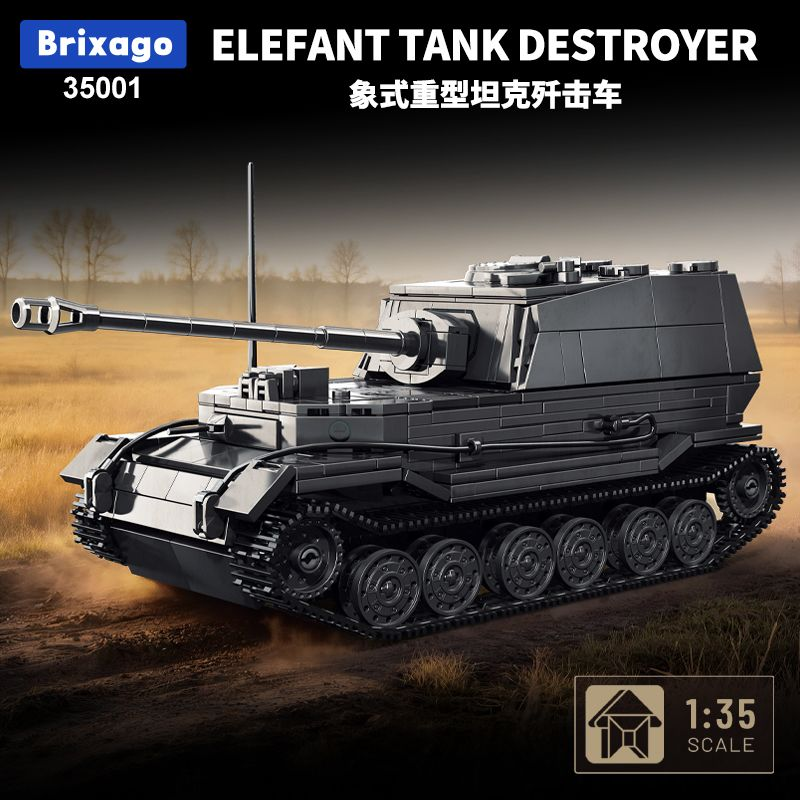
Elefant Tank Destroyer
- 35001Catalog number
- 12GOManufacturer
- 1110Pieces
- 1:35Scale
- 23.6 × 10.1 × 12.6 cmProduct size
- 42 × 25 × 9 cmPackage size
- 6+Age
- ABS plasticMaterial
Top offers for Elefant Tank Destroyer
Current prices for Elefant Tank Destroyer at partner stores (sorted lowest first).
 AfobrickBest price$25.30incl. shippingCode PBRICKS: 5% offView offer
 BarweerCheck store for priceView offer
 YourwobbCheck store for priceCode PBRICKS: 4% offView offer
 AliExpressCheck store for priceView offer
 Amazon (EU)Check store for priceView offer
- Amazon (US)Check store for priceView offer
Prices may change. We may earn a commission if you buy via partner links — at no extra cost to you.
About Elefant Tank Destroyer set
Discover one of the most distinctive German armoured vehicles of World War II with the Brixago Elefant 35001 building set. This detailed brick-built replica recreates the Elefant heavy tank destroyer, originally known as the Ferdinand. The vehicle stood out for its formidable main gun, heavy frontal armour and massive fixed fighting compartment, which replaced the conventional rotating turret found on most tanks.
The set contains 1110 pieces and is designed in 1:35 scale. Once assembled, the model measures approximately 23.6 cm long, 10.1 cm wide and 12.6 cm high. Its dark grey finish, long gun barrel, tracked chassis and carefully recreated exterior details give it a distinctive military appearance. It is an appealing choice for fans of World War II armoured warfare and collectors looking to add a less conventional vehicle to their display.
The model includes several engaging construction features. The main gun can be raised or lowered, allowing its elevation angle to be adjusted. Opening hatches on the upper structure provide access to the interior, while the removable fighting compartment makes it easier to examine the hull and internal layout. Selected interior components and elements of the powertrain are represented inside. Detailed tracks, road wheels and exterior fittings complete the design.
The Brixago Elefant 35001 combines an enjoyable building experience with an opportunity to explore an unusual chapter of military engineering. Once completed, it makes a striking display piece for a shelf, desk or World War II vehicle collection. Its 1:35 scale and 1110 pieces provide an engaging construction project while keeping the finished model compact enough to fit comfortably into most collections.
Specifications
- Brand: Brixago
- Name: Elefant Tank Destroyer
- Set Number: 35001
- Piece Count: 1110
- Scale: 1:35
- Assembled Dimensions: Approx. 23.6 × 10.1 × 12.6 cm
- Packaging Dimensions: Approx. 42 × 25 × 9 cm
- Age: 6+
Product Features
- Brand: Brixago
- Name: Elefant Tank Destroyer
- Set Number: 35001
- Piece Count: 1110
- Scale: 1:35
- Assembled Dimensions: Approx. 23.6 × 10.1 × 12.6 cm
- Packaging Dimensions: Approx. 42 × 25 × 9 cm
- Age marking shown on the box: 6+
- Elevating main gun with adjustable angle
- Opening hatches on the upper fighting compartment
- Removable fighting compartment for access to the interior
- Interior details and recreated powertrain components
- Detailed tracks and road wheels
- Dark grey finish inspired by historic military vehicles
- Building set designed for assembly and collector display
Historical Background: Elefant — The Heavy Tank Destroyer Born from Porsche's Tank Project
The story of the Elefant began with the competition to develop a new German heavy tank. In the early 1940s, Ferdinand Porsche was working on his own design, designated VK 45.01 (P), which competed against a proposal from Henschel. Porsche's design featured an unusual petrol-electric drive system: petrol engines powered generators, which supplied electricity to motors that drove the tracks. Although technically ambitious, the arrangement was complex and difficult to maintain. The German authorities ultimately selected the Henschel design, which became the basis of the Tiger I.
By the time Porsche's proposal was rejected, however, a number of chassis had already been built. Rather than abandon the completed work, the German military decided to repurpose these chassis as heavy tank destroyers. In 1943, a heavily armoured fixed superstructure was fitted to the Porsche-derived chassis, carrying the powerful 8.8 cm PaK 43/2 L/71 anti-tank gun. The resulting vehicle was known as the Ferdinand and was officially classified as a tank destroyer.
The long-barrelled gun provided excellent armour penetration and enabled the vehicle to engage enemy tanks at considerable distances. Heavy frontal armour offered further protection, but the design also had significant drawbacks. The vehicle was extremely heavy, demanded extensive maintenance and had limited gun traverse because it lacked a conventional rotating turret. Early Ferdinands also lacked a hull-mounted machine gun for close defence against infantry. Their effectiveness therefore depended not only on firepower and armour, but also on reconnaissance, infantry support and favourable terrain.
The Ferdinand first saw major combat during the German offensive at Kursk in July 1943. Its powerful gun posed a serious threat to Soviet armoured vehicles, especially in open terrain where it could exploit its range advantage. At the same time, mines, mechanical breakdowns and difficulties recovering disabled vehicles reduced its operational effectiveness. The Ferdinand's great weight made battlefield recovery and field repairs particularly challenging, while close-range fighting exposed the limitations of its secondary armament.
Following the 1943 campaign, some surviving vehicles were rebuilt. Improvements included a commander's cupola, a forward machine-gun mounting and other changes intended to make the vehicle more effective in combat. The modified vehicles received the name Elefant. They later saw service in Italy and on the Eastern Front. Production nevertheless remained limited, and the vehicle's mechanical complexity and maintenance requirements continued to restrict its usefulness.
The Elefant occupies a distinctive place in German armoured history. It combined formidable firepower and heavy frontal protection, yet also illustrated the compromises involved in converting a chassis originally designed for a tank into a specialised tank destroyer. Today, its unusual design makes it an engaging subject for military history enthusiasts and collectors. The Brixago model captures its recognisable silhouette and offers an opportunity to explore its construction through a hands-on building project.